

Digital Marketing services for Small Businesses
How to Build a Complete Growth System Without Hiring a Full Marketing Team
Why Digital Marketing Has Become Essential for Small Businesses
Running a small business today is more challenging than ever. Customers are no longer discovering companies only through recommendations, physical locations, or traditional advertising. Before making a purchase decision, they search online, compare options, read reviews, visit websites, check social media profiles, and evaluate whether a company looks trustworthy.
This is why digital marketing for small businesses has become one of the most important investments for sustainable growth.
However, many small businesses face the same problem: they know they need marketing, but they do not know where to start, which channels to prioritize, or how to build a system that consistently generates leads.
Hiring a full internal marketing team is often unrealistic. A professional marketing department requires specialists in SEO, content creation, advertising, design, social media, analytics, automation, and strategy. For many small businesses, this can cost tens of thousands of dollars every month.
This is where a fractional marketing team becomes a powerful solution.
Instead of hiring multiple full-time employees, businesses can access an experienced team of marketing specialists who work as an extension of their company. This approach provides the expertise, strategy, and execution needed to compete online without the excessive cost and complexity.
At CreativeUP, we provide digital marketing services to small businesses and build complete systems by combining strategy, creativity, technology, and execution into one flexible outsourced marketing solution.
What Is Digital Marketing for Small Businesses?
Digital marketing for small businesses refers to the process of promoting products and services through online channels to attract, engage, and convert potential customers.
Unlike traditional advertising, digital marketing allows businesses to target specific audiences, measure results, and continuously improve performance.
The main purpose is not simply to get more visibility. The purpose is to create a predictable system that generates:
- More qualified leads
- More customer inquiries
- Stronger brand awareness
- Higher customer trust
- Better return on investment
A successful digital marketing system usually combines several channels:
- Website optimization
- Search Engine Optimization (SEO)
- Google Ads
- Social media marketing
- Content marketing
- Email marketing
- Marketing automation
- Analytics and conversion optimization
The mistake many small businesses make is treating these activities separately.
Posting occasionally on social media, running random advertisements, or publishing a blog article once every few months does not create predictable growth.
Successful businesses build systems where every marketing activity supports another.
Want to check where your business stands online
Generate a free Marketing Audit report to see your entire marketing presence and points where need improvements.

Why Digital Marketing Is Critical for Small Businesses in 2026
The buying process has changed permanently.
Customers have more choices than ever before, and businesses compete not only with companies in their local area but also with competitors from around the world.
A potential customer may:
- Search Google for a solution.
- Visit several websites.
- Compare reviews.
- Check social media.
- Look for expertise and credibility.
- Contact the company they trust most.
If your business does not appear during this journey, your competitors will.
Digital marketing gives small businesses the opportunity to compete with larger organizations by focusing on:
Visibility
SEO and content marketing help customers discover your business when they search for solutions.
Trust
Professional websites, valuable content, testimonials, and consistent communication create credibility.
Customer Relationships
Email marketing and automation help businesses stay connected with potential customers.
Measurable Growth
Unlike traditional advertising, digital marketing provides data that shows what works and what needs improvement.
The Biggest Marketing Challenges Small Businesses Face
Many small businesses struggle with digital marketing not because they lack ambition, but because they lack resources and expertise.
Common challenges include:
1. No Clear Strategy
Many businesses start marketing without a plan.
They create social media posts, try advertisements, or redesign their website without understanding:
- Who their ideal customer is
- Which channels provide the best results
- How customers move from awareness to purchase
Without strategy, marketing becomes expensive experimentation.
2. Limited Time
Business owners already manage:
- Operations
- Customers
- Employees
- Finances
- Sales
Adding marketing responsibilities creates another full-time job.
3. Lack of Specialized Skills
Modern marketing requires multiple disciplines:
- SEO specialists
- Designers
- Copywriters
- Paid advertising experts
- Web developers
- Data analysts
- Automation specialists
Finding one person who can master everything is extremely difficult.
4. Inconsistent Execution
Marketing success requires consistency.
A business cannot expect results from:
- One social media post per month
- Occasional advertisements
- An outdated website
Growth requires continuous improvement.
The Essential Digital Marketing Activities Every Small Business Needs
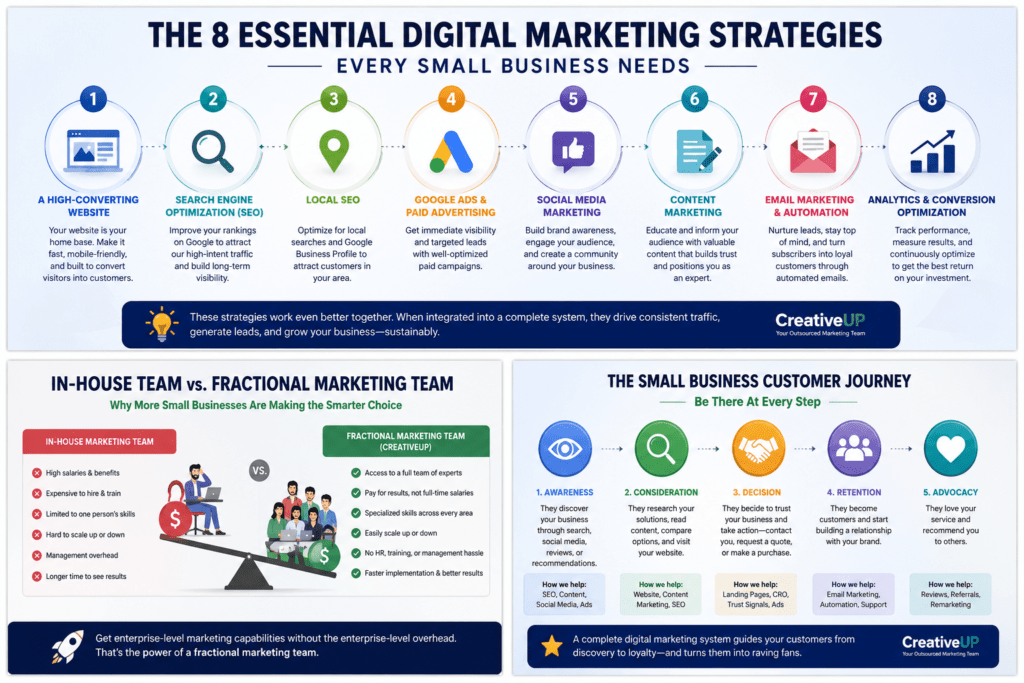
1. A High-Converting Website
Your website is the foundation of your digital presence.
A website should not only look professional. It should convert visitors into customers.
A successful business website needs:
- Clear messaging
- Strong calls-to-action
- Mobile optimization
- Fast loading speed
- Trust signals
- Search engine optimization
Your website should answer:
- Who are you?
- What problem do you solve?
- Why should customers choose you?
- How can they contact you?
2. Search Engine Optimization (SEO)
SEO helps your business appear when potential customers search online.
For small businesses, SEO can create long-term visibility without paying for every click.
Effective SEO includes:
- Keyword research
- Website optimization
- Technical SEO
- Content creation
- Internal linking
- Authority building
A strong SEO strategy helps businesses attract customers who already have buying intent.
3. Local SEO
For many small businesses, local customers are the most valuable audience.
Local SEO helps businesses appear in searches such as:
- “digital marketing agency near me”
- “best restaurant in [city]”
- “accountant for small business”
Important elements include:
- Google Business Profile optimization
- Reviews
- Local content
- Location pages
- Citations
4. Google Ads and Paid Advertising
SEO creates long-term visibility, but paid advertising can generate immediate opportunities.
Google Ads allows businesses to appear when customers actively search for their services.
A successful advertising campaign requires:
- Correct targeting
- Strong landing pages
- Compelling copy
- Conversion tracking
- Continuous optimization
5. Social Media Marketing
Social media is not only about posting content.
It is about building relationships and increasing brand trust.
Effective social media marketing includes:
- Educational content
- Customer stories
- Behind-the-scenes content
- Engagement
- Community building
6. Content Marketing
Content marketing positions your business as an expert.
Examples include:
- Blog articles
- Guides
- Videos
- Case studies
- Industry insights
High-quality content helps attract customers before they are ready to buy.
7. Email Marketing and Automation
Email marketing remains one of the most effective channels for nurturing relationships.
Businesses can use automation to:
- Welcome new leads
- Follow up with prospects
- Share educational content
- Promote offers
- Maintain customer relationships
8. Analytics and Conversion Optimization
Marketing without measurement is guesswork.
Businesses need to understand:
- Which channels generate leads
- Which campaigns produce sales
- Which pages convert visitors
- Where improvements are needed
Data-driven decisions create better results.
Get your Free 90 days Digital marketing blueprint
Why a Fractional Marketing Team Is the Smartest Solution for Small Businesses?
A traditional marketing department requires hiring multiple specialists.
For example:
- Marketing manager
- SEO specialist
- Designer
- Content writer
- Paid advertising specialist
- Web developer
- Automation specialist
For many small businesses, this is financially impossible.
A fractional marketing team provides access to all these capabilities without the burden of full-time salaries.
Access to Multiple Experts
Instead of relying on one employee, businesses gain access to a complete team.
Lower Costs
Businesses pay for expertise when they need it instead of maintaining expensive permanent positions.
Faster Implementation
Experienced marketing teams already have:
- Processes
- Tools
- Strategies
- Experience
This reduces the time required to start generating results.
A Complete System Instead of Random Activities
The biggest advantage is integration.
A fractional marketing team does not only create posts or run advertisements.
It builds a complete growth system.
At CreativeUP, our approach combines:
- Strategy
- Website development
- SEO
- Content
- Design
- Social media
- Advertising
- Automation
Everything works together toward one goal: business growth.
How CreativeUP Helps Small Businesses Grow Online?
CreativeUP works as an outsourced digital marketing department for businesses that need professional marketing expertise without building an expensive internal team.
We help companies create:
- Strong digital foundations
- Better online visibility
- Consistent content systems
- Lead generation campaigns
- Marketing automation workflows
- Conversion-focused websites
Our goal is simple:
Help small businesses compete with larger companies by giving them access to the marketing capabilities they need.
Want to start growing your business through digital marketing?
How Much Should a Small Business Invest in Digital Marketing?
The right investment depends on:
- Industry
- Competition
- Goals
- Current online presence
A small business should think about marketing as an investment rather than an expense.
The question is not:
“How much does marketing cost?”
The better question is:
“How much revenue can a strong marketing system generate?”
A professional fractional marketing team allows businesses to access advanced capabilities while keeping costs predictable.
Frequently Asked Questions
Is digital marketing worth it for small businesses?
Yes. Customers increasingly search online before purchasing. Without digital visibility, businesses lose opportunities to competitors.
Should small businesses hire an internal marketing team?
For many small businesses, hiring internally is expensive. A fractional marketing team provides similar capabilities at a more flexible cost.
How long does digital marketing take to produce results?
SEO and content marketing usually require consistent effort over time, while advertising can generate faster results.
What services should small businesses prioritize first?
Most businesses should begin with a strong website, SEO foundation, clear messaging, and a lead-generation strategy.
Why choose an outsourced marketing/Fractional team?
Because businesses gain access to specialists, proven processes, and strategic guidance without managing multiple employees internally.
Final Thoughts
Digital marketing for small businesses is no longer optional. It is one of the most powerful ways companies can attract customers, build trust, and compete in today’s marketplace.
The challenge is not understanding that marketing is important.
The challenge is building and managing a complete marketing system.
That is why many businesses are choosing fractional marketing teams.
Instead of hiring an entire department, they gain access to experienced professionals who work as an extension of their company.
CreativeUP helps small businesses build that system — combining strategy, creativity, technology, and execution to create sustainable digital growth.